

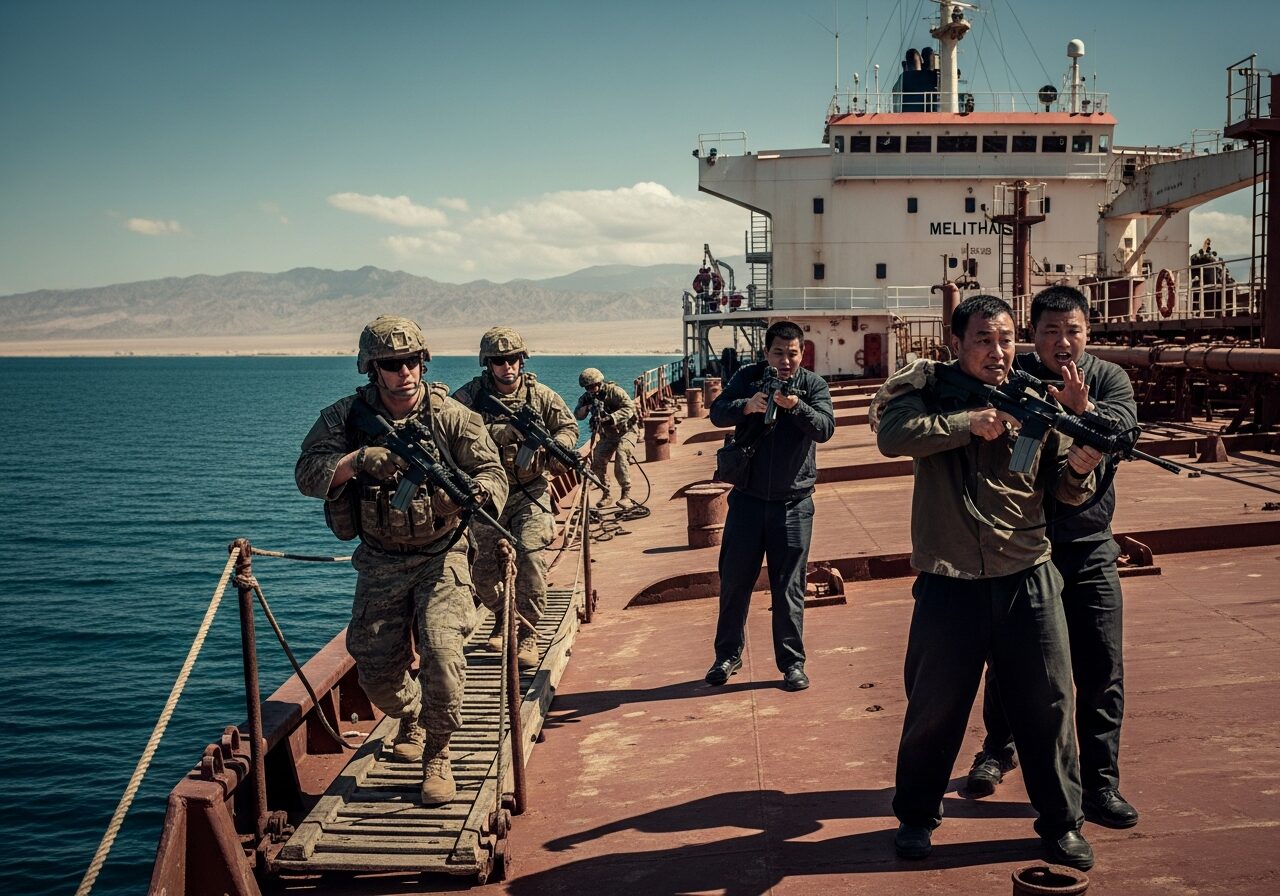
Nine tankers. Twenty million barrels of Iranian crude. All of it bound for Chinese ports. Total value: $4 billion. The US Navy grabbed every last barrel, and now Tehran and Beijing are both pretending they don’t know what anyone’s talking about.
Whoops. That’s an expensive oops.
Let’s talk about what Iran has been running here. For years — going back to 2013 — Iran has been operating a “ghost fleet” of aging tankers that switch off their transponders, forge their registration documents, and sneak oil past international sanctions. They do ship-to-ship transfers in the middle of the ocean like some kind of floating flea market. The destination? China. Always China.
These nine tankers alone delivered 20.3 million barrels of Iranian crude to Chinese ports between 2013 and 2025. But that’s just the Iranian piece. The same ghost fleet network hauled 37.9 million barrels of Venezuelan crude and 11.1 million barrels of Russian crude to China during the same period. Beijing has been running a discount oil bazaar funded by every sanctioned regime on the planet.
A report from Republicans on the House Select Committee on China — using data from Kpler, the commodity tracking firm — laid out the full picture. In 2025 alone, China received one-third of all crude oil carried by shadow and sanctioned tankers worldwide. A third. They weren’t just buying sanctioned oil on the side. They were the primary customer.
Here’s the detail that really ties it together. The ghost fleet tankers were using China’s BeiDou satellite navigation system instead of GPS. Why? Because BeiDou lets them “operate outside Western oversight.” So China wasn’t just buying the oil — they were providing the navigation system that helped Iran hide the shipments. That’s not a customer. That’s an accomplice.
The previous administration’s approach to Iran’s oil smuggling was to issue press releases expressing “deep concern.” Iran responded by increasing exports. Shocking.
The Navy’s approach was different. They took the oil.
Twenty million barrels is a serious number. Iran exports roughly 1.5 million barrels a day to China — almost all of it in violation of sanctions. Losing 20 million barrels is like having two weeks of revenue vanish in one afternoon. At current prices, that’s approximately $100 million a day in lost income. The math gets ugly fast for a regime that funds 60% of its budget with oil revenue.
But the real damage isn’t the barrels they lost. It’s the barrels they won’t be able to ship next month. Insurance companies are doing new math right now. The tanker operators who’ve been running Iran’s ghost fleet are recalculating the risk premium on every future shipment. Every captain of every ghost fleet vessel is wondering whether the next shadow on the horizon is the US Navy.
Cut Iran’s oil revenue by even 30% and they can’t pay the Revolutionary Guard. They can’t fund Hezbollah. They can’t keep developing ballistic missiles. When the money dries up, the proxies dry up. And the proxies are the only reason Iran matters on the world stage.
Nine tankers down. $4 billion seized. The ghost fleet just met the US Navy, and it turns out ghosts aren’t bulletproof.