
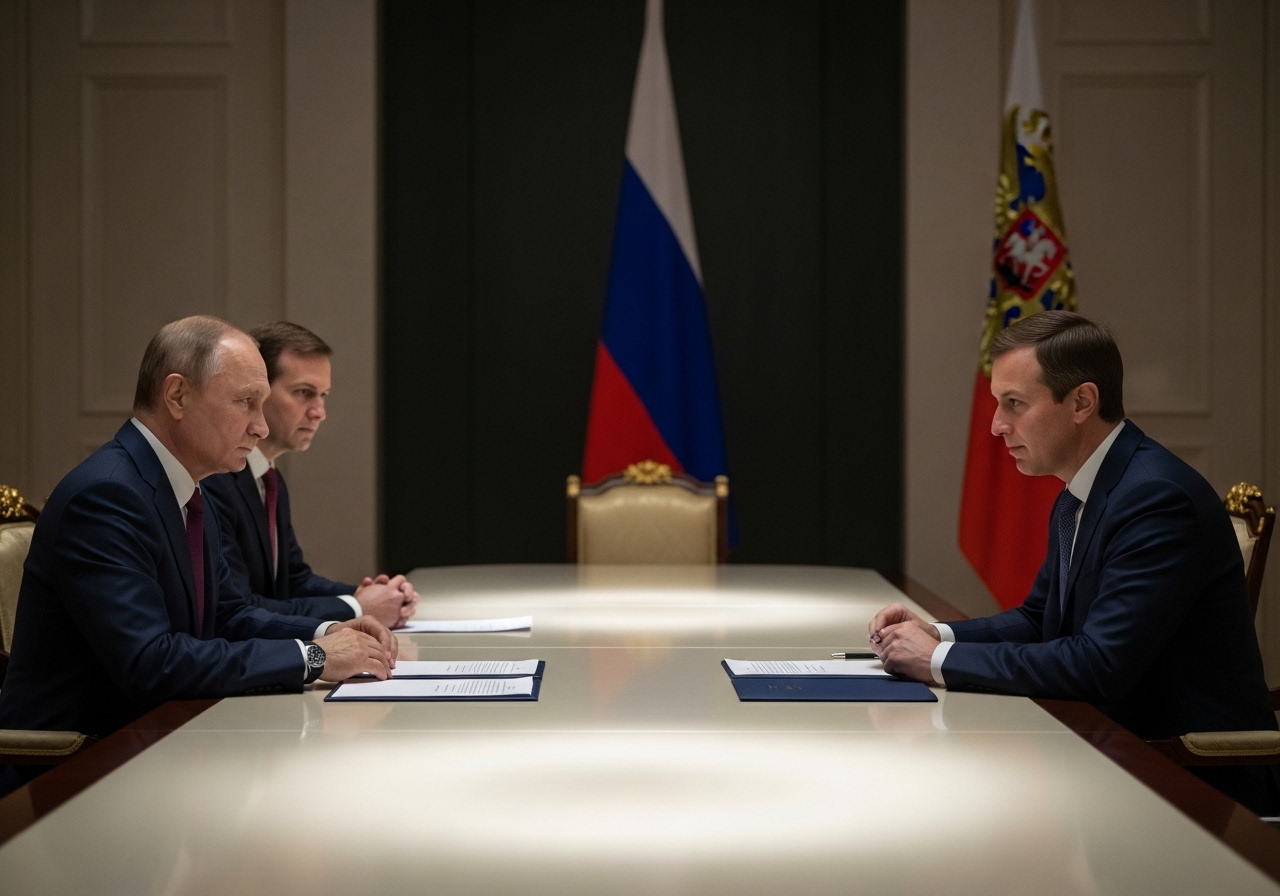
The recent five-hour meeting in Moscow between Russian President Vladimir Putin, U.S. Special Envoy Steve Witkoff, and Jared Kushner, President Trump’s trusted advisor and son-in-law, did not bring a final solution to the long and painful war in Ukraine. However, it was a serious and meaningful step in the right direction. While no peace deal was signed, the talks showed that the United States, under President Trump’s leadership, is once again taking bold and direct action to bring stability to a troubled region.
It is important to understand what this meeting means. For over two years, the war in Ukraine has claimed countless lives and destroyed many homes. Families have been torn apart. Cities have been reduced to rubble. The conflict has not only hurt the people of Ukraine but has also shaken the peace and economy of Europe, and by extension, the world. This war is a tragedy, and it must end — not with weakness, not by surrender, but with strength, wisdom, and fairness.
That is precisely why President Trump sent two trusted men — Steve Witkoff and Jared Kushner — to speak directly with President Putin. They carried with them new ideas and proposals, including a revised peace plan made after consulting with Ukrainian officials just days earlier. According to reports, they handed over four documents, one containing 27 points, outlining American proposals to move toward peace.
Russian officials described the talks as “extremely useful” and “constructive.” That sort of language matters. It means the Russians are taking the U.S. proposals seriously. It also shows that America is once again speaking from a place of strength, not bowing to global agendas or hiding behind empty words.
Still, there are major challenges ahead. The largest sticking point remains the territory in eastern Ukraine. Putin wants control of the entire Donbas region, even parts Russia does not currently hold. That demand is not something Ukraine can easily accept, and rightly so. No nation wants to give up its land. But peace will never come without hard discussions about borders and sovereignty.
The road ahead will not be easy. The Russian side admitted that while some of the American proposals were “more or less acceptable,” some parts still need work. This is how real diplomacy works — not through flashy press conferences or applause from global elites, but through serious, behind-the-scenes talks that push both sides toward a solution.
Meanwhile, the fighting continues. Reports show that Russian forces have pushed forward in several regions, including Sumy Oblast and near cities like Pokrovsk and Huliaipole. Ukraine continues to defend its ground bravely, holding onto cities like Kupiansk despite Russian pressure. These are not just battles over land. They are battles over freedom, identity, and the right of a people to choose their own future.
Ukrainian President Volodymyr Zelenskyy has said that his team is preparing for further talks in Brussels and later in the United States. This is a good sign. Both sides are still talking. Both sides are still engaged. And both sides know that the leadership of the United States, under President Trump, is serious about bringing peace — not the kind of peace that comes from surrender, but a peace based on strength, respect, and fairness.
The American people should be proud. Under President Trump, we are once again leading the world toward peace, not war. We are standing up for our values and pushing back against the chaos unleashed by years of weak leadership and globalist policies. The meeting in Moscow may not have ended the war, but it showed that America is back at the table — not to bow, but to lead.
And that is exactly where we belong.