
The “Make America Health Again” movement has been riding a wave of victories under President Trump.
Fluoride drug products for children pulled from the market. mRNA vaccine development contracts canceled. Serious moves toward eliminating synthetic dyes and questionable additives from the food supply.
For many MAHA supporters, it felt like the long-overdue health reset had finally begun.
Then came the executive order that left some of Trump’s most loyal health advocates stunned.
On Wednesday, President Trump invoked the Defense Production Act of 1950 to ramp up domestic production of controversial glyphosate-based herbicides — calling them “a cornerstone of this Nation’s agricultural productivity and rural economy.” He warned that limiting access to glyphosate would “result in economic losses for growers and make it untenable for them to meet growing food and feed demands.”
Characterizing production of glyphosate-based herbicides as “central to American economic and national security,” Trump directed Agriculture Secretary Brook Rollins to ensure “a continued and adequate supply.” The order also grants legal immunity to American manufacturers compelled to produce glyphosate-related herbicides.
For many in MAHA, that was a record scratch moment.
Glyphosate, first registered in the United States in 1974, is among the most widely used pesticides in the country. The U.S. Environmental Protection Agency maintains that “there are no risks of concern to human health when glyphosate is used in accordance with its current label” and that it “is unlikely to be a human carcinogen.”
But critics have long questioned those assurances.
The International Agency for Research on Cancer classified glyphosate as “probably carcinogenic to humans.” Trump’s own MAHA Commission report, released in May, acknowledged that “a selection of research studies on a herbicide (glyphosate) have noted a range of possible health effects, ranging from reproductive and developmental disorders as well as [sic] cancers, live inflammation and metabolic disturbances.”
A 2023 study published in Environmental Health Perspectives — referenced in that same MAHA report — found that childhood exposure to glyphosate and its breakdown product, aminomethylphosphonic acid, “may increase risk of liver and cardiometabolic disorders in early adulthood, which could lead to more serious diseases later in life.”

A 2019 study in BMJ identified an association between autism spectrum disorder and prenatal glyphosate exposure. Researchers wrote that their findings “suggest that an offspring’s risk of autism spectrum disorder increases following prenatal exposure to ambient pesticides within 2000 m of their mother’s residence during pregnancy, compared with offspring of women from the same agricultural region without such exposure.”
Last year, a long-term study in Environmental Health reported that low doses of glyphosate caused various cancers in rats. The researchers stated their findings “support the IARC conclusion that there is ‘sufficient evidence of carcinogenicity [of glyphosate] in experimental animals,” and are “consistent also with the epidemiological evidence showing increases in incidence of multiple malignancies in humans exposed to glyphosate and GBHs.”
For MAHA activists, those findings aren’t abstract.
Zen Honeycutt, executive director of Moms Across America, told The Defender, “The implications of this executive order are irreversible.”
“Not only has Trump gone back on his word to go after pesticides, destroying the delicate trust that was being built by the MAHA movement with the government, but he paved the path for glyphosate to continue destroying farmland, fertility, and our families’ health for generations to come,” Honeycutt added.
Toxicologist Alexandra Munoz wrote on X, “The executive branch has just endorsed a carcinogen and enshrined it. This is outrageous and unacceptable.”
Vani Hari, founder of Food Babe, offered a broader indictment: “EVERY PRESIDENT since glyphosate was invented has increased the amount of glyphosate being sprayed on our farm land. The Chemical Lobby is controlling Washington, no matter who is in charge & this is why I hate politics.”
The timing only intensified suspicions.
Trump’s executive order landed one day after Bayer — which acquired Roundup from Monsanto — proposed a $7.25 billion settlement to resolve thousands of lawsuits alleging the company failed to warn consumers that Roundup could cause cancer. Bayer emphasized that “the settlement agreements do not contain any admission of liability or wrongdoing.”
CEO Bill Anderson stated, “The proposed class settlement agreement, together with the Supreme Court case, provides an essential path out of the litigation uncertainty and enables us to devote our full attention to furthering the innovations that lie at the core of our mission: Health for all, Hunger for none.”
Bayer also donated $1 million to Trump’s 2025 inauguration committee.
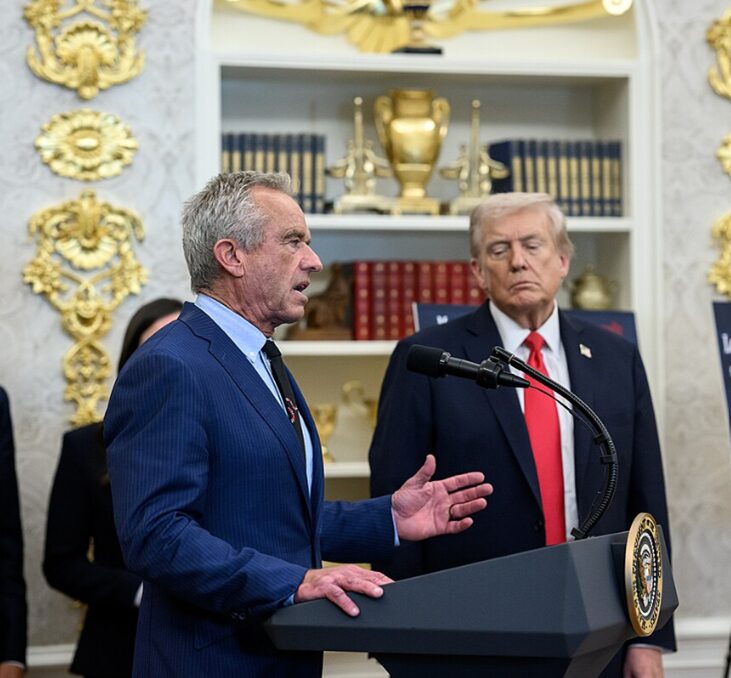
Health and Human Services Secretary Robert F. Kennedy Jr., who previously called glyphosate a “poison” and helped Dewayne Johnson win a case in which a jury found Roundup caused his cancer, defended the move.
“Donald Trump’s executive order puts America first where it matters most — our defense readiness and our food supply,” Kennedy told CNBC. “We must safeguard America’s national security first, because all of our priorities depend on it. When hostile actors control critical inputs, they weaken our security. By expanding domestic production, we close that gap and protect American families.”
For some MAHA supporters, that national security argument may carry weight.
For others, it feels like a stunning reversal.
The movement built on eliminating toxins from American life now finds itself confronting a difficult question: can “America First” include a chemical many of its own allies consider dangerous?
That tension is now impossible to ignore.